Week 24, 2026
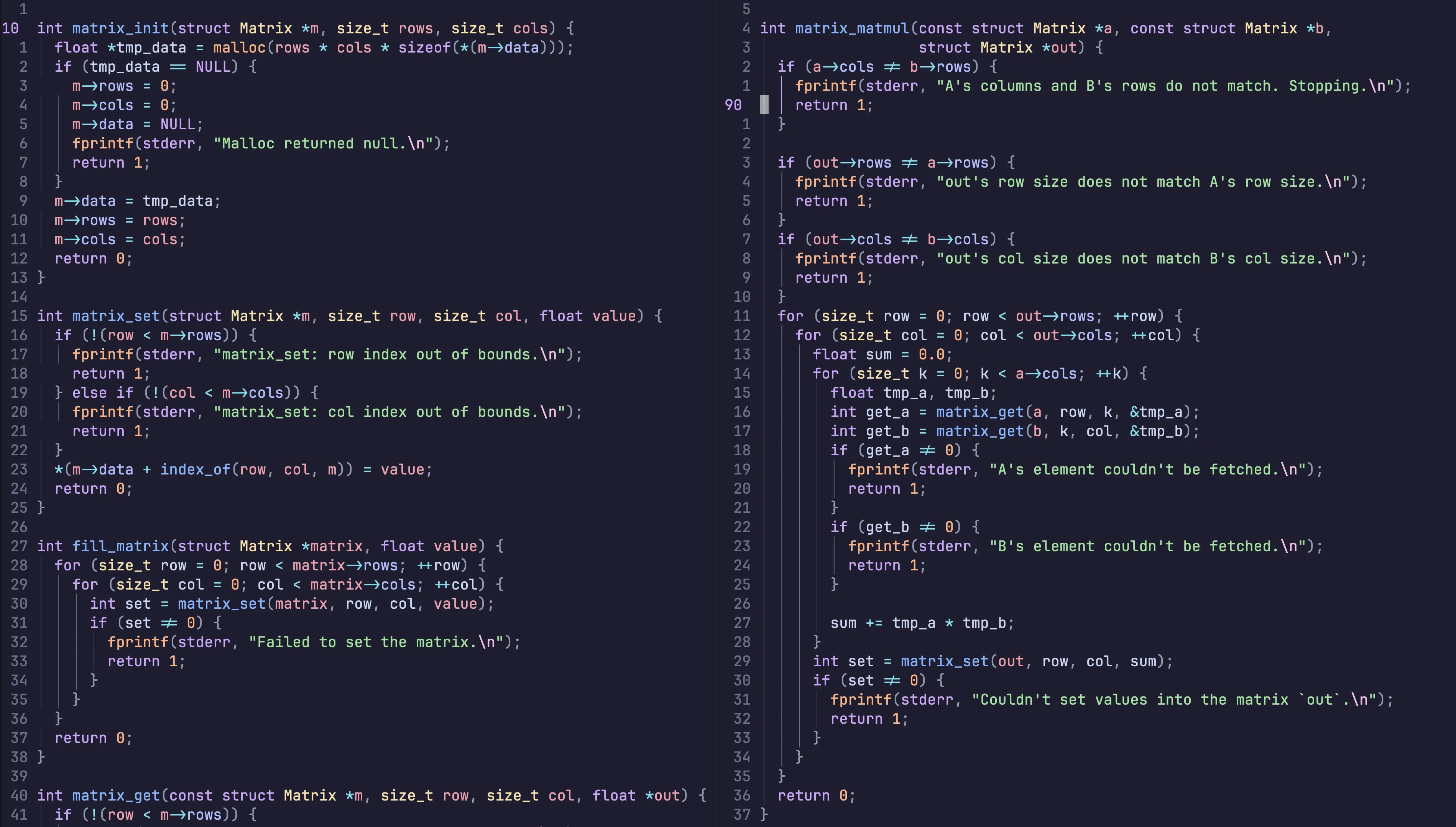
This was mostly a week of getting my C base in order before going back to CUDA. I think I’ll spend a few more weeks on this, but no more than 3. I want the foundations to be boringly solid before I continue with PMPP.
This Week: Memory, Pointers, Structs, Flat Arrays
Indexing
The line that kept showing up was:
data[row * cols + col]This is just a tiny indexing formula, but I believe this is the thing I need to become fluent with before tensors and CUDA feel natural. Remember seeing something similar for calculating the global index of threads in the PMPP book too.
A matrix here is just a flat chunk of floats with shape metadata. If the matrix has rows = 2
and cols = 3, then the value at row 1, column 2 lives at:
data[1 * 3 + 2]Quite a straightforward thing, but I believe it touches almost everything I need later: memory layout, bounds checks, ownership, and cache behavior.
The pointer stuff
I started from the very basics: what a pointer stores, what the pointed-to value is, and who is responsible for freeing heap memory. I still need reps here, but my mental model is much less foggy now:
float *data = malloc(rows * cols * sizeof *data);
free(data);
Struct
If a helper receives a pointer to the struct, I can’t write matrix.data; I need to follow the
pointer first:
matrix->data
matrix->rows
matrix->cols
That also made some helper functions that I wrote feel more natural. In the exercises I did,
index_of was the small row-major helper, matrix_init owned allocation, matrix_free owned
cleanup, and the accessors kept the bounds checks in one place:
static size_t index_of(size_t row, size_t col, const struct Matrix *matrix) {
  return row * matrix->cols + col;
}
Include guard
The header file split was another useful concept that I knew of already, but learning the declaration/definition boundary and why the header gets wrapped was good.
#ifndef MATRIX_H
#define MATRIX_H

// declarations

#endif
Naive matmul
Matrix multiplication was the first exercise that made the dimensions matter in a non-trivial way:
(2 x 3) @ (3 x 4) -> (2 x 4)
             ^
          shared k
The function should not secretly allocate the result. The caller creates the output with the right shape, and the function either fills it or rejects the call.
Naive transpose
The transpose work I’m doing is still very vanilla, but the core idea has been:
out[col, row] = matrix[row, col]And I kept using the stricter build setup from last week:
cc -std=c11 -Wall -Wextra -Werror -g -O1 -fsanitize=address,undefined -fno-omit-frame-pointer ...Next Week
- Start thinking about row-major access patterns and cache locality.
- Slowly move from small matrix helpers toward a tiny CPU tensor library.
- Hoping to also read at least two model release technical reports: Arcee Trinity + one more
Basically, plan is to be done with my C practice with the aim of creating at least some form of a working tiny CPU Tensor library. Of course, I don’t need to be ensuring that I do it perfectly - that will come eventually as I resume the PMPP book after these next (hopefully) 2 weeks of C munching. Current thought process is that this book will guide me to also gradually write the CUDA backend for the existing library modules and eventually just help me nurture this library into a proper C/CUDA Tensor library.