Attention-Only vs. All-Layer LoRA: A Worklog
This is the worklog version of the LoRA and Friends experiment.
The final public artifacts are:
- model checkpoints: sumitdotml/lora-and-friends
- dataset: sumitdotml/lora-and-friends-dataset
1. Before The Run
2026-04-19: the first plan had too many moving parts
I started with too many possible experiments in the air: full fine-tuning, MoE, RL, transfer evaluation, Tinker defaults, LoRA target modules, dataset choice, benchmark choice, and budget. That was not a runnable project but a pile of directions.
I removed most of it. Phase one became:
- one model:
Qwen3-8B - one task family: math reasoning
- one final benchmark anchor:
GSM8K - one supervised fine-tuning comparison: attention-only LoRA vs all-layer LoRA
I kept Qwen3-8B as the working model. Qwen3-8B-Base stayed in reserve for a different post-training story, and a smaller future model would have added a model-choice variable that I did not want in the first comparison.
The target-module comparison was the part I wanted to isolate:
| condition | intended adapter scope |
|---|---|
attention_only | attention projections |
all_layer | attention and MLP projections |
That meant everything else had to become boring on purpose: same base model, same data, same rank, same training schedule, same evaluation prompt, same answer extraction, same benchmark, and same checkpoint-selection rule.
Why GSM8K became the benchmark, not the main training set
GSM8K was tempting as a training source because it is clean and familiar. But the train split has only 7,473 rows, and the test split has 1,319 rows. I wanted the final score to be held out and easy to explain, so I kept GSM8K as the benchmark anchor.
The training source moved to nvidia/OpenMathInstruct-2, especially the train_1M split. The schema was simple enough to render into chat format:
{
	"problem": "Solve for $y$:\n\n$$\\frac{y^2 - 3y + 2}{y - 2} = y + 1$$",
	"generated_solution": "... \\[ y = \\boxed{2} \\]",
	"expected_answer": "2",
	"problem_source": "augmented_math"
}
I also looked at unsloth/OpenMathReasoning-mini. It had more character and much longer traces, but the token profile made it harder to fit into the budget. OpenMathInstruct-2 looked less exciting, but it had the right shape for a controlled SFT comparison.
The first sizing pass made the budget concrete. A 500-row tokenizer sample from OpenMathInstruct-2 averaged 456.9 rendered tokens per example, with p90 = 813 and p95 = 963. At Tinker’s then-current Qwen3-8B training price of $0.40 / M tokens, a 30k-example run started to look feasible.
The first target was a mildly balanced 30k dataset:
30k working raw dataset
- 21,000  augmented_math
-  7,000  augmented_gsm8k
-  1,000  math
-  1,000  gsm8k
The first plan did not survive.
The first run sheet was useful even though it was wrong
The first run sheet had a training split of 27,000 rows and a validation split of 3,000 rows. With the early weighted mean estimate, that came out to about 11.70M train tokens per epoch and about $4.68 per epoch.
The pilot shape was also already there:
pilot sweep
- train rows: 5,000
- val rows:     500
- 2 conditions x 3 LR values x 1 seed x 1 epoch
And the main comparison shape was visible:
thesis comparison
- 2 conditions x 3 seeds x 2 epochs
- total train cost: about $56.17
Those numbers were later superseded, but they were still useful. They forced me to think in runs, seeds, rows, tokens, and dollars instead of treating “fine-tune a model” as one vague action.
The benchmark side looked cheap in comparison. One full GSM8K eval was estimated around cents, not dollars of training cost. So from the beginning, training data and training schedule were the real budget levers.
2. Before Training
2026-04-20: the first dataset looked usable until I read it
The initial openmath_30k artifacts matched the recipe exactly: 27,000 train rows and 3,000 validation rows. Structurally it looked clean. Every inspected training row had a final \boxed{...} answer. The first rendered dataset under qwen3_disable_thinking also looked reasonable.
Then the manual audit started doing its job.
One sampled augmented_gsm8k row reasoned itself into clipping a percentage answer to 100 because a fictional budget was too small. A tetrahedron row noticed a fractional tetrahedron count was impossible and still pushed through to a final ratio. A pattern search found disclaimer-like repair language:
cannot spend more than she has
doesn't align with the logical outcome
we need to set the value to 100
At first I treated this as a light cleanup problem. I removed a couple of flagged rows, built filtered artifacts, and added manual review packs. The mismatch count fell, the obvious bad rows got smaller, and the dataset felt closer.
But each pass exposed another class of issue.
The augmented branch kept asking for another pass
The suspicious rows were concentrated in the augmented sources. The failures were not all the same, but they had a family resemblance: impossible integer counts, prompt-generation residue, unsupported case-bashing, and answers that looked right only because the generated reasoning had quietly changed the problem.
The review packs were small enough to inspect but large enough to change my mind. A 53-row suspicious train pack for curated_v2 produced 29 removals. A later 61-row suspicious train pack produced 30 hard removals, all from augmented_math. These were not tiny formatting mismatches but rows with broken reasoning, contaminated prompts, or invalid proofs.
The curation sequence became longer than I wanted:
curated_v2: after the first train and validation suspicious-row removalscurated_v3: after another suspicious train reviewcurated_v4: after validation cleanupcurated_v5: after backfilling weakaugmented_mathrowscurated_v6: after removing prompt-generation debris likeA new problem:andThe new problem is:
One excerpt from the log captures the real issue:
The problem was no longer "find one more regex,"
it was "stop trusting augmented_math as the backbone of the dataset."
At that point I stopped trying to rescue the 30k augmented-heavy recipe. If the dataset takes repeated repair passes and still produces obvious bad rows in random review, then it stops being a clean experimental input and becomes the experiment itself.
I did not want the final write-up to be “attention-only LoRA versus all-layer LoRA, but also maybe the augmented data had hidden garbage.” That would have made every downstream result harder to trust.
2026-04-20 to 2026-04-21: I rebuilt around original rows only
OpenMathInstruct-2 train_1M had 29,468 original-source rows across gsm8k and math. After the strict gate, 28,166 survived cleanly enough to build a new candidate.
The accepted source counts were:
{
	"gsm8k": 14618,
	"math": 13548
}
The original-only dataset was smaller than the 30k target, but the quality profile was much better. It cleared the automatic checks that the augmented branch kept failing:
- boxed-match rate, train:
1.0 - boxed-match rate, validation:
1.0 - suspicious rows, train:
0 - suspicious rows, validation:
0 - prompt-wrapper contamination hits, train:
0 - prompt-wrapper contamination hits, validation:
0
I froze this path as openmath_original_clean.
After a later split repair, the final retained manifest became:
| split | gsm8k source rows | math source rows | total |
|---|---|---|---|
| train | 13,145 | 12,203 | 25,348 |
| validation | 1,473 | 1,345 | 2,818 |
The old openmath_30k* lineage was retired after that. I wanted one clear dataset path in the repo, not a dozen stale artifact branches that future-me or another agent might accidentally treat as active.
2026-04-21: I kept the system prompt
The render sanity check compared the frozen dataset with and without the system prompt under the actual Qwen/Qwen3-8B chat template. The prompt added a constant 27 tokens per example.
{
	"full_mean_with_system": 340.25,
	"full_mean_without_system": 313.25,
	"full_mean_delta": 27.0
}
That overhead was small enough to keep. More importantly, the prompt made the output contract explicit:
You are a careful math solver. Solve the problem step by step. Put the final answer in \boxed{}.I kept it because the raw problems themselves do not always carry the boxed-answer instruction. I also wanted training and evaluation to mirror each other as closely as possible.
3. Contracts And Sanity Checks
2026-04-22: I stopped relying on memory
Once the dataset path was stable, the next risk was format drift. It is easy to train with one prompt, evaluate with another, parse answers a third way, and then accidentally report a prompt experiment as a model experiment.
So I wrote the contracts down before the final result existed.
I also had to clean up the planning docs. Some TODO labels were too compressed. A label like “contamination check” made sense to me while I was in the middle of the work, but it hid the actual operation: compare training-side gsm8k problem text against held-out GSM8K test questions after canonical normalization, then block training if overlap is greater than zero.
So I added an execution-clarity rule for the project: open tasks needed to say what the action was, why it mattered, what counted as done, and what happened if it failed. It sounds procedural, but it kept the later runbook from turning into shorthand only I could decode.
The evaluation contract froze:
- the same system prompt as training
- greedy decoding with
temperature = 0 enable_thinking=Falsemax_new_tokens = 512- no custom stop tokens
- boxed-answer extraction only
- exact match after normalization
- the contamination report path
The contamination check was a gate, not a note. If training-side gsm8k rows overlapped the GSM8K test questions, the benchmark had to change or the dataset had to be rebuilt.
The result schema was frozen around retained JSONL output under artifacts/results/<run_id>/. It also kept token_count and cost in the canonical schema even when those values were null, because I did not want the schema to change later just because telemetry became available.
I also standardized on the word condition for the comparison label, which sounds minor but made later artifacts easier to read:
{
	"condition": "attention_only",
	"seed": 0,
	"step": 3169
}
2026-05-03: the dataset split still had a hidden problem
When I ran the dataset-integrity gate, the benchmark side passed. The training-side gsm8k rows had 0 overlap with the openai/gsm8k test split.
But the local train/validation split failed a different check. OpenMath can include multiple accepted solutions for the same underlying problem. The original builder had split rows independently, so variants of the same problem could land on both sides.
That would make validation loss too friendly. It would also make checkpoint or LR decisions look cleaner than they were.
The fix was to group by canonical problem text before splitting. The retained report after the rebuild says:
{
	"status": "pass",
	"overlap_count": 0,
	"train_val_overlap": {
		"row_id_overlap_count": 0,
		"problem_text_overlap_count": 0,
		"overlapped_val_row_count": 0
	}
}
The final contamination report compared 13,145 training rows with source == "gsm8k" against 1,319 GSM8K test questions. It found overlap_count = 0.
The raw files were not enough on their own, and the split rule mattered.
2026-05-04: the dataset went to Hugging Face
After the repaired split, the frozen dataset payloads were published to sumitdotml/lora-and-friends-dataset.
The local repo kept scripts, manifests, checksums, and audit evidence. The Hub repo carried the payloads:
| payload | rows | bytes |
|---|---|---|
| raw train | 25,348 | 25,528,287 |
| raw validation | 2,818 | 2,787,397 |
| rendered train | 25,348 | 29,989,535 |
| rendered validation | 2,818 | 3,283,365 |
At this point I had a real dataset, a render path, an evaluation contract, and a contamination gate. I still did not know whether the training path would work.
4. First Tinker Check
2026-05-04: the first backend check caught a renderer trap
The first Tinker smoke pass was supposed to be boring. It was one of the smallest checks in the whole project: can Tinker accept Qwen/Qwen3-8B, rank 8, and the two LoRA condition switches?
The Tinker cookbook qwen3_disable_thinking renderer was correct for generation prompts, but its supervised-training path did not match the frozen SFT render contract. The project contract was the Hugging Face chat template with enable_thinking=False, which renders an empty thinking block before the assistant answer:
<think>

</think>
I changed the smoke runner so Tinker datums came from AutoTokenizer.apply_chat_template(..., enable_thinking=False), then masked loss only after the rendered prompt prefix.
The retained smoke pass then gave me enough to lock the adapter defaults:
| condition | train rows in smoke | optimizer steps | validation NLL |
|---|---|---|---|
attention_only | 1 | 1 | 1.5048651695251465 |
all_layer | 8 | 1 | 1.4733978509902954 |
Tinker accepted:
{
	"attention_only": {
		"train_attn": true,
		"train_mlp": false,
		"train_unembed": false
	},
	"all_layer": {
		"train_attn": true,
		"train_mlp": true,
		"train_unembed": false
	}
}
The public Tinker API did not expose local lora_alpha or lora_dropout fields through this training path. I recorded those as backend-owned instead of pretending the runner controlled them.
There was one more small backend detail in the log: the first smoke attempt printed that the Tinker SDK version was outdated. I upgraded to tinker==0.18.2, reran the smoke pass, and the warning did not reappear. Backend version drift becomes hard to reconstruct later, so I kept the note.
The smoke pass also created checkpoint paths with a seven-day TTL. That did not matter for the final result yet, but it foreshadowed the export urgency after the main sweep.
2026-05-05: I ran the untouched baseline before touching LoRA
The baseline was Qwen/Qwen3-8B on openai/gsm8k, config main, split test, with enable_thinking=false, temperature=0, and max_new_tokens=512.
The retained baseline run was:
artifacts/results/baseline-qwen3-8b-gsm8k-001/It scored:
- examples:
1,319 - correct:
1,115 - accuracy:
0.8453373768006065 - extraction failures:
31 - total eval tokens:
505,694
I wanted this number before LR selection and before the main comparison. Otherwise, the final LoRA scores would float without a reference.
5. Learning Rate And Batch Shape
2026-05-06: the LR-selection plan was too slow
The first LR-selection protocol used 5,000 train rows and 500 validation rows. On paper it was reasonable. In practice it projected to roughly 20 hours for the six-run sweep on Tinker.
I rescaled it to a deterministic slice:
- first
512train rows - first
128validation rows - seed
7 - LR grid:
1e-4,3e-4,1e-3 - two conditions
- one epoch
- effective batch size
8
The narrow purpose was to choose a peak LR per condition, not to run a final benchmark or a condition comparison.
The selected LR was 3e-4 for both:
| condition | LR | best validation NLL |
|---|---|---|
attention_only | 1e-4 | 0.3786645046540731 |
attention_only | 3e-4 | 0.3632619345728878 |
attention_only | 1e-3 | 0.3644437038722405 |
all_layer | 1e-4 | 0.3648794147648033 |
all_layer | 3e-4 | 0.3559855057286731 |
all_layer | 1e-3 | 0.37397296784836664 |
I kept seed 7 reserved for selection work so the main comparison seeds could be 0, 1, and 2.
The LR-selection runner also caught a plain implementation bug before the expensive runs. I had assumed Tinker cookbook datum weights were raw torch tensors. They were TensorData objects. The live one-step probe failed, the runner got fixed, and that mistake went into AGENT_MISTAKES.md. The final result depends on the boring part where a runner can survive a one-step live probe before it is trusted for a sweep.
I also split the training helper code into smaller modules:
training/common.pytraining/sft.pytraining/lora.py
The runnable scripts stayed separate: one for the smoke pass, one for LR selection, and later one for the main training sweep. This kept the orchestration scripts readable enough that I could still inspect what was being frozen.
2026-05-07: speed was tempting, but batch size was not free
The initial runner shape used eight one-datum train requests before each optimizer step. A throughput probe showed that request shape mattered a lot at the same effective batch size:
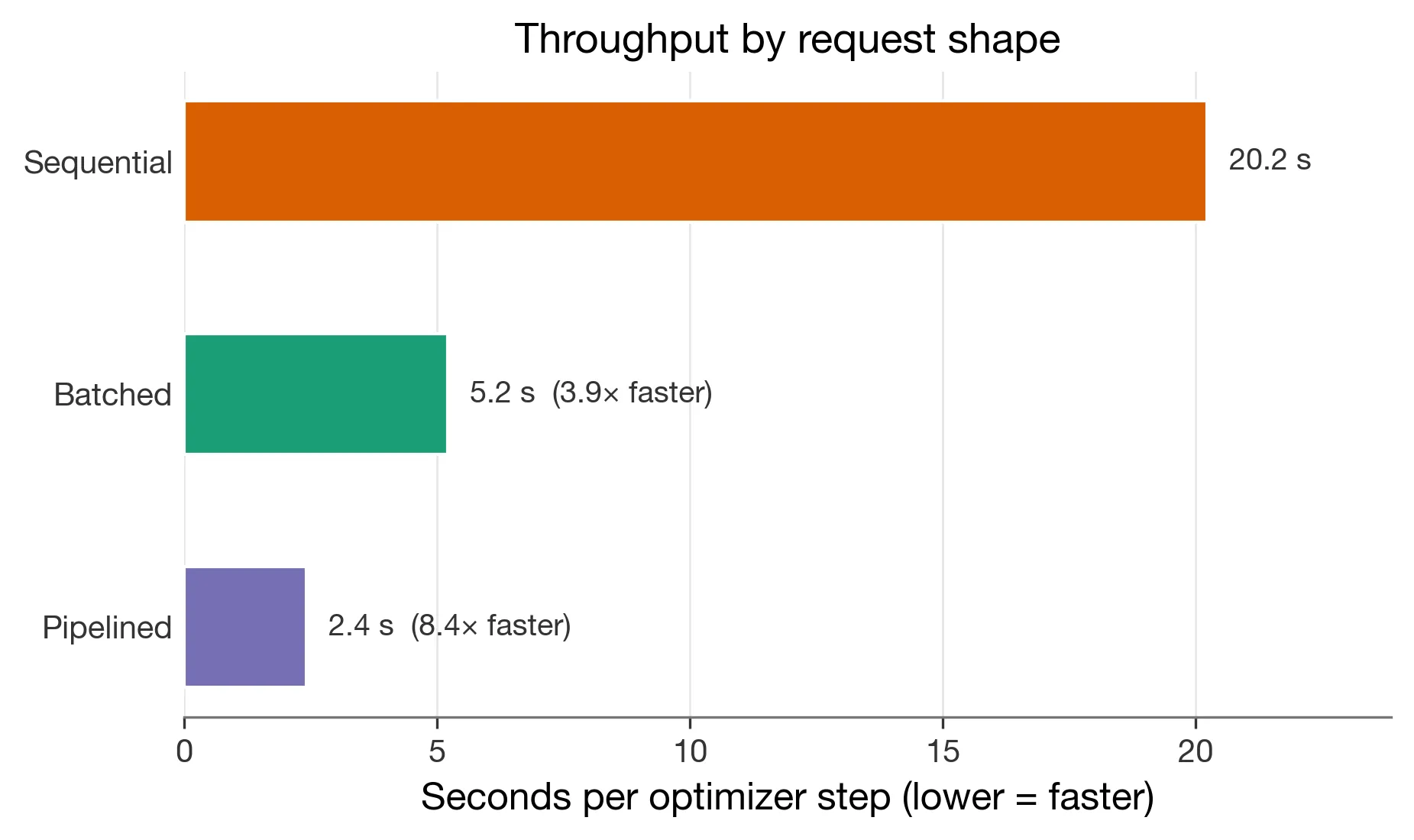
| request shape | seconds per optimizer step |
|---|---|
single_datum_calls | 20.22187466151081 |
batched_datums | 5.201307859155349 |
batched_datums_pipelined | 2.4104866901249693 |
The fast version, batched_datums_pipelined, submits one batched forward_backward_async(...) request and queues the optimizer request before waiting. That kept the nominal effective batch size at 8; it only changed how the same batch was sent to Tinker.
Then larger batches looked tempting. Batch 512 and 1024 were much faster in throughput probes. But batch size is a real hyperparameter for LoRA, so I made the larger-batch path earn its way in by validation NLL, and it did not.
| condition | selected batch/LR | selected NLL | best larger-batch candidate | candidate NLL |
|---|---|---|---|---|
attention_only | batch 8, 3e-4 | 0.3632619345728878 | batch 512, 1e-3 | 0.37616809419132946 |
all_layer | batch 8, 3e-4 | 0.3559855057286731 | batch 512, 1e-3 | 0.3569802998485914 |
So the main run kept effective batch size 8, used the pipelined request shape, and kept the final partial batch of 4 rows rather than wrapping around and duplicating examples. The fast path was real, but it was only allowed to change operations, not silently change the scientific comparison.
6. The Six Runs
2026-05-08: main-001 started
The main run expanded to six sequential condition/seed runs:
main-001-attention_only-seed-0main-001-attention_only-seed-1main-001-attention_only-seed-2main-001-all_layer-seed-0main-001-all_layer-seed-1main-001-all_layer-seed-2
The launch command was:
uv run training/run_main_training.py --run-prefix main-001Each run used:
- train rows:
25,348 - validation rows:
2,818 - epochs:
2 - effective batch size:
8 - optimizer steps per epoch:
3,169 - total optimizer steps:
6,338 - warmup steps:
190 - peak LR:
3e-4 - min LR:
3e-5
The validation/checkpoint cadence was 1000, 2000, 3169, 4000, 5000, 6000, and 6338.
I monitored this like a long-running job, because it was one. The raw log has many repeated entries that look boring at first glance:
validation step=1000 nll=...
validation step=2000 nll=...
validation step=3169 nll=...
...
Those entries showed that the run was still alive, that validation/checkpoint blocks resumed correctly, and that every retained checkpoint path was read from the active run rather than guessed from a sibling run.
I had already made that mistake once while logging a checkpoint URL by analogy from a sibling run. The fix was simple: read the exact checkpoint string from the active run’s metrics.jsonl or summary before writing it down. After that, I treated checkpoint paths as evidence, not as strings I could reconstruct from memory.
Step 3169 kept showing up
The first attention-only seed hit:
main-001-attention_only-seed-0: validation step=3169 nll=0.336164Its final summary selected step 3169, not the final step 6338:
selected best validation step: 3169
selected validation_mean_nll: 0.33616363178874076
Then seed 1 selected step 3169, then seed 2, then all-layer seed 0, then all-layer seed 1, then all-layer seed 2.
At the end, every run selected the one-epoch boundary:
| run | selected step | validation NLL |
|---|---|---|
main-001-attention_only-seed-0 | 3169 | 0.33616363178874076 |
main-001-attention_only-seed-1 | 3169 | 0.33621202263413363 |
main-001-attention_only-seed-2 | 3169 | 0.33651007850933906 |
main-001-all_layer-seed-0 | 3169 | 0.33611938013674597 |
main-001-all_layer-seed-1 | 3169 | 0.33655583715915666 |
main-001-all_layer-seed-2 | 3169 | 0.33634131648081267 |
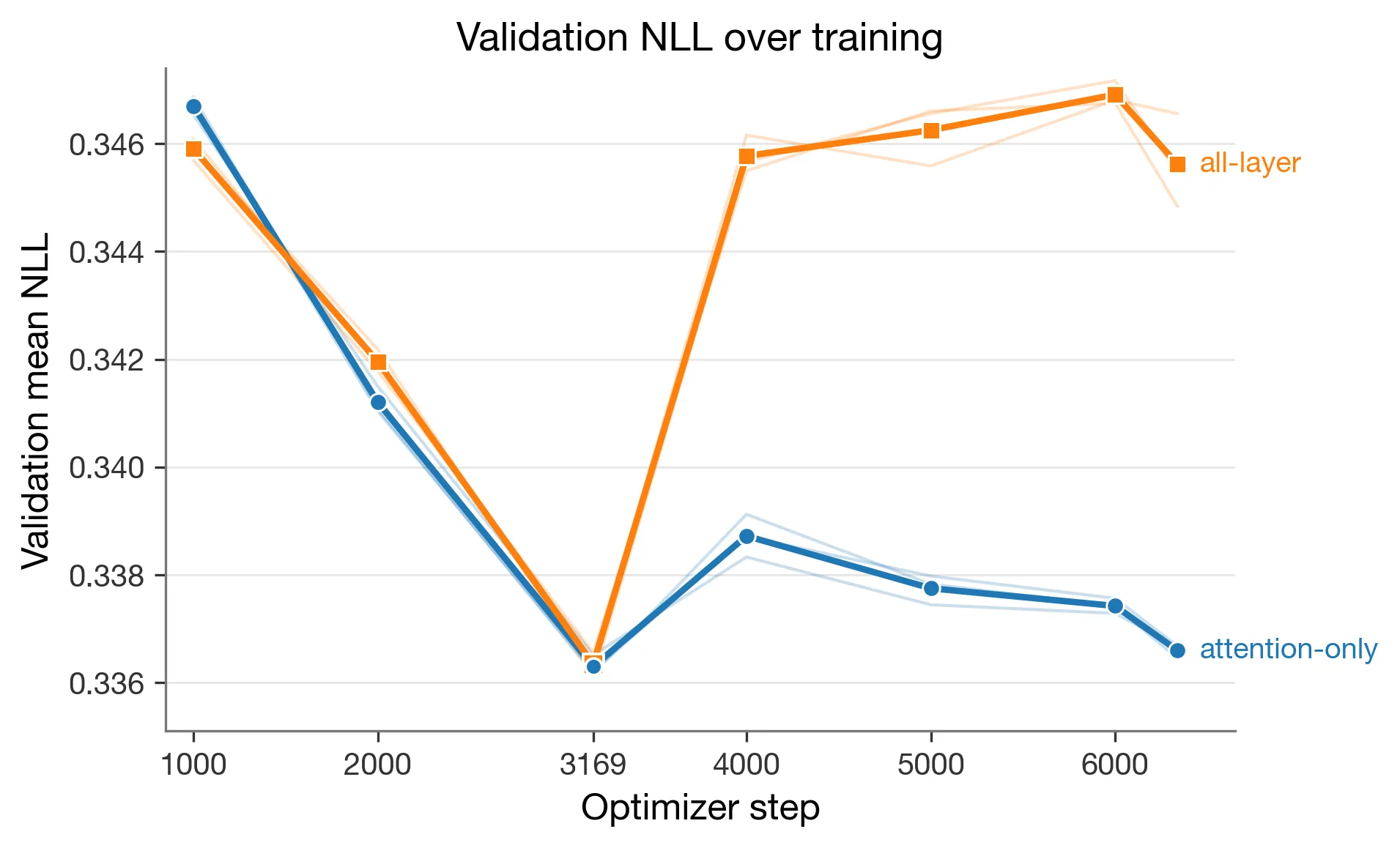
The selected NLL means were close:
attention_only:0.3362952443107378all_layer:0.3363388445922384
But the post-3169 behavior was different. Attention-only stayed near the selected NLL. All-layer jumped more sharply after the one-epoch boundary; at step 4000, all-layer mean NLL was 0.3457733619534809.
I did not treat that as the final result though; it was a training diagnostic, and the actual comparison still had to come from GSM8K.
For all-layer seed 1, the NLL moved from 0.33655583715915666 at step 3169 to 0.34549824556309505 at step 4000. For all-layer seed 2, it moved from 0.33634131648081267 to 0.3461580484910246.
The lowest-NLL checkpoint rule prevented later checkpoints from becoming attractive simply because they were later or because the run had continued longer.
The sweep finished with six pass summaries
The final all-layer seed completed on 2026-05-09. The log entry was satisfying because the sweep had finally become a finite object:
completion artifacts now exist in artifacts/results/main-001-all_layer-seed-2/:
manifest.json, metrics.jsonl, sample_render.txt, summary.json
Each of the six selected checkpoints had a seven-day Tinker TTL, so the next step was urgent enough: export the selected checkpoint states into something that could be evaluated and published.
7. Checkpoint Export
2026-05-09: training weights were not sampler weights
The selected training checkpoints used weights/... paths. I initially wanted to use those directly for publication/evaluation, but the sampling client rejected that shape.
The actual server response was:
tinker.BadRequestError: Error code: 400 - {'detail': 'model_path must point to a sampler_weights checkpoint, got weights'}So the selected training state checkpoints had to be converted to sampler-format weights before any evaluation could run.
The working export path was:
load_state_async(training_checkpoint_path)
save_weights_for_sampler_async(export_name)
The six sampler checkpoint URIs then looked like:
tinker://.../sampler_weights/export-main-001-attention_only-seed-0-step-3169
tinker://.../sampler_weights/export-main-001-all_layer-seed-2-step-3169
After that, the converted adapters were uploaded to the Hugging Face model repo. The published layout is:
checkpoints/best-checkpoints/attention_only/seed-{0,1,2}/step-3169/
checkpoints/best-checkpoints/all_layer/seed-{0,1,2}/step-3169/
The sampler weights also made the adapter-size difference concrete. The attention-only sampler exports were about 30.8M bytes each in the Tinker checkpoint listing, while the all-layer sampler exports were about 87.5M bytes each. That was expected from the larger adapter scope, but it was useful to see it in the retained checkpoint metadata rather than only as intuition.
8. GSM8K Evaluation
2026-05-10: the evaluation runner needed checkpoint awareness
The baseline path already existed, but checkpoint evaluation needed more safeguards. I added support for:
--checkpoint-path- explicit
--seed - explicit
--condition - a run-id slug that would not collide when checkpoint paths ended similarly
- step parsing only from literal
step-<digits>tokens
I also made the argument validation fail fast if a checkpoint path was passed without condition or seed. I did not want a LoRA checkpoint quietly defaulting to base.
Before launching the full sweep, I ran a one-example probe with attention_only seed 0. It returned 1/1 correct and confirmed the full path:
sampler URI -> tokenizer -> Tinker sample -> boxed-answer extraction -> scoring -> retained artifactsThe six eval runs
The full sweep ran at --concurrency 16, no limit, against the six selected sampler checkpoints.
The baseline stayed:
- accuracy:
0.8453373768006065 - correct:
1115/1319 - extraction failures:
31
The six LoRA eval runs were:
| condition | seed | accuracy | correct / total | extraction failures |
|---|---|---|---|---|
attention_only | 0 | 0.9044730856709629 | 1193 / 1319 | 6 |
attention_only | 1 | 0.9067475360121304 | 1196 / 1319 | 2 |
attention_only | 2 | 0.9052312357846853 | 1194 / 1319 | 5 |
all_layer | 0 | 0.8991660348749052 | 1186 / 1319 | 5 |
all_layer | 1 | 0.9021986353297953 | 1190 / 1319 | 4 |
all_layer | 2 | 0.9014404852160728 | 1189 / 1319 | 8 |
Aggregated by condition:
| condition | mean accuracy | min | max | range |
|---|---|---|---|---|
attention_only | 0.9054839524892596 | 0.9044730856709629 | 0.9067475360121304 | 0.0022744503411676 |
all_layer | 0.9009350518069245 | 0.8991660348749052 | 0.9021986353297953 | 0.0030326004548901 |
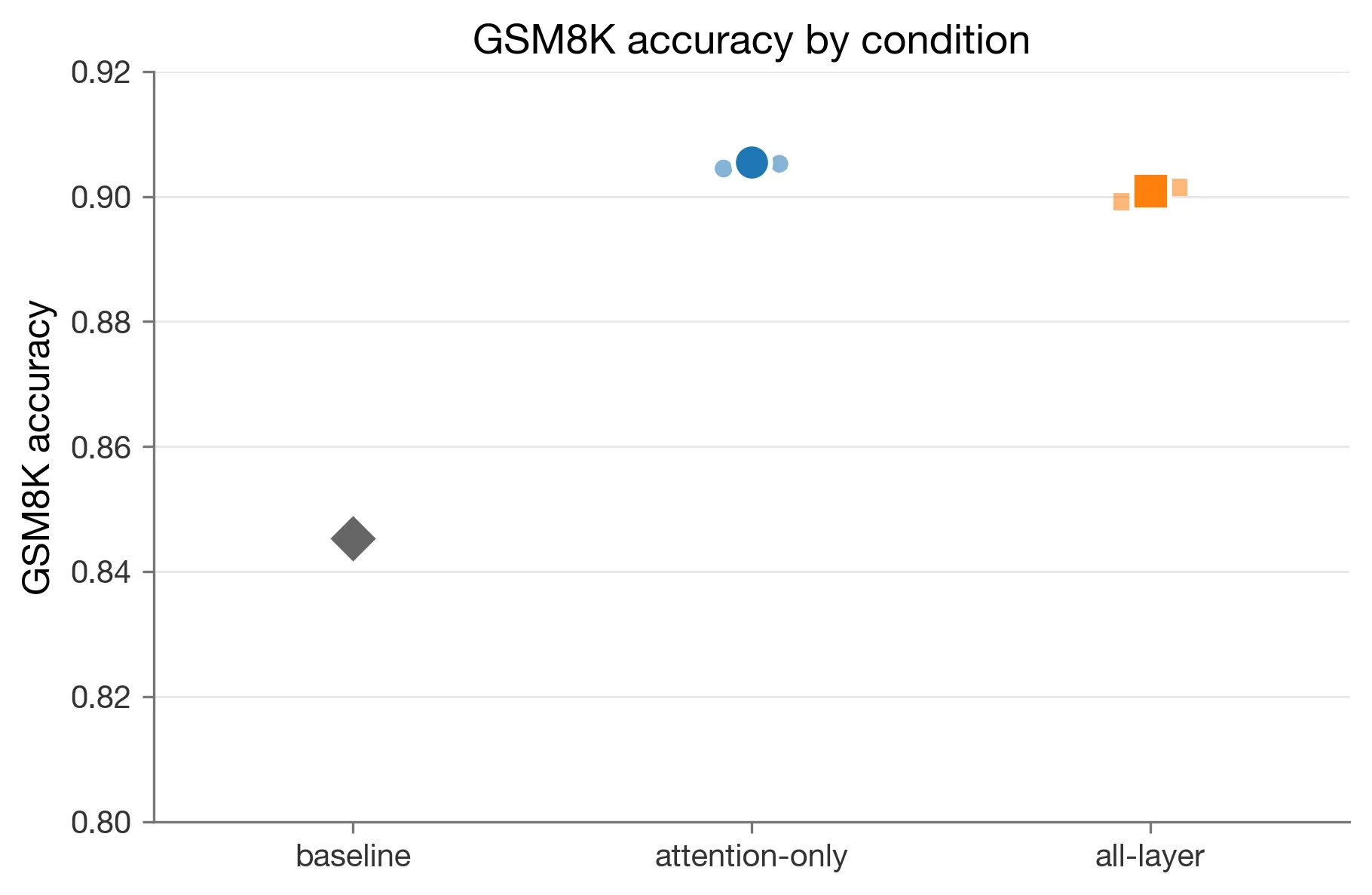
The mean gap was 0.0045489006823352, or about 0.455 percentage points, in favor of attention-only. Under the frozen rule, that is below the 0.01 threshold for a winner claim. So the honest reading is local: attention-only ended higher in this run set and used a smaller adapter, but the result stays inside the pre-declared inconclusive band.
The disagreement view made the result easier to read
The net accuracy chart showed the final result, but the disagreement chart explained its shape better.
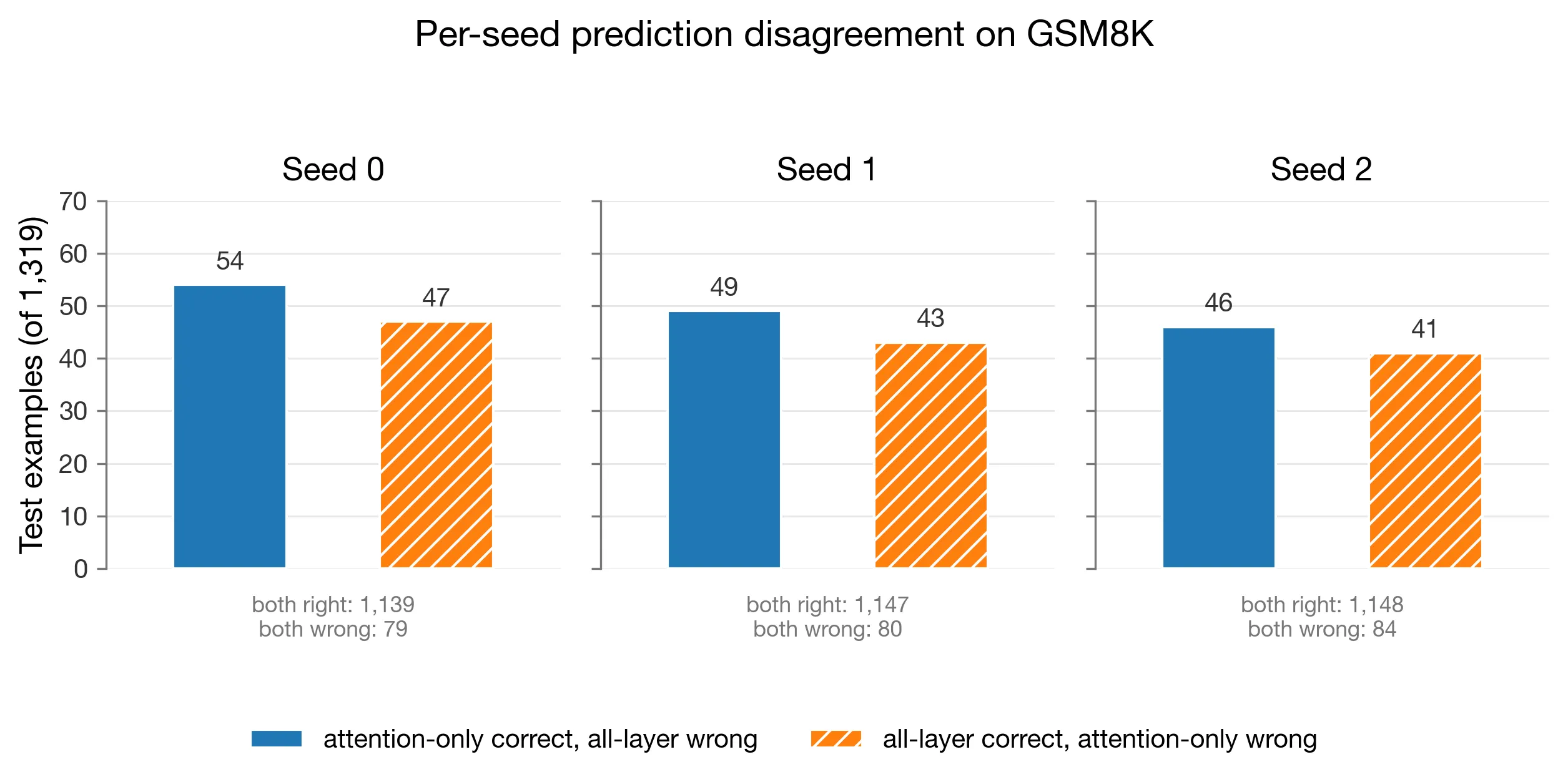
For paired seeds:
| seed | attention-only only | all-layer only | both correct | both wrong | delta |
|---|---|---|---|---|---|
| 0 | 54 | 47 | 1139 | 79 | +7 |
| 1 | 49 | 43 | 1147 | 80 | +6 |
| 2 | 46 | 41 | 1148 | 84 | +5 |
The two conditions mostly agree, with the difference coming from a narrow band of examples where attention-only is correct slightly more often than the reverse.
9. Figures And Cleanup
2026-05-10: the figure pass changed how I told the result
The figure pipeline produced eight retained artifacts. This worklog uses four of them:
fig_03: GSM8K accuracy by conditionfig_04: per-seed prediction disagreementfig_05: validation NLL by training stepfig_08: throughput by request shape
The figure pass forced me to separate claims that were getting blurred together:
- validation NLL explains checkpoint selection
- GSM8K accuracy explains benchmark performance
- prediction disagreement explains the narrow accuracy gap
- throughput explains an operational runner choice
The fig_04 design took the most iteration. The original idea was a slope/delta view showing net correct-count deltas of +7, +6, and +5. It kept reading like a progression over time or a tiny effect exaggerated by the axis.
The raw log records several rejected forms: vertical slope, leader labels, corner text boxes, horizontal dumbbell, vertical paired columns, and delta-only bars. The recurring problem was that the visual form was louder than the claim. A 0.4 to 0.5 percentage-point gap should not be drawn like a dramatic swing.
The final chart became per-seed disagreement small multiples. That matched the actual question better: where do the two conditions disagree?
The log records the final contingency numbers before implementation:
seed 0: attention_only_only=54, all_layer_only=47, both_correct=1139, both_wrong=79
seed 1: attention_only_only=49, all_layer_only=43, both_correct=1147, both_wrong=80
seed 2: attention_only_only=46, all_layer_only=41, both_correct=1148, both_wrong=84
I kept the filename as fig_04_paired_seed_slope so existing artifact paths did not move, but the chart itself became the disagreement view.
The cleanup rule
The result can say:
- both LoRA conditions improved over the untouched baseline on GSM8K
- attention-only had the higher three-seed mean in this retained run set
- attention-only had a small paired-seed disagreement edge
- the gap is below the frozen
0.01threshold for a winner claim
The result cannot say:
- attention-only LoRA is generally better
- all-layer LoRA is bad
- the same result should hold across other ranks, models, datasets, or benchmarks
- validation NLL explains the benchmark gap as a mechanism
10. What This Leaves Me With
The final comparison was the easy sentence at the end of a lot of setup.
- I started too broad and had to cut the project down to one comparison.
- I thought the first dataset recipe was close, then the audits kept proving otherwise.
- I abandoned the augmented-heavy branch because it made the dataset itself the unstable variable.
- I kept the system prompt because the output contract needed to be explicit.
- I froze the eval contract before the result existed.
- I had to repair train/validation leakage by grouping canonical problem text.
- The smoke pass caught a render mismatch before paid runs.
- LR selection picked
3e-4for both conditions. - Throughput work mattered, but only after batch size stayed controlled.
- All six main runs selected step
3169. - Training checkpoints had to be converted to sampler weights before evaluation.
- The disagreement chart was more honest than only talking about a mean gap.
The result is small, but the path to making it trustworthy was not.
If I were doing the next version, I would keep the same discipline: narrow the question first, freeze contracts before seeing benchmark numbers, treat dataset audits as part of the experiment, and make every convenience change prove that it does not change the comparison. The follow-up question I would carry forward is when a narrower adapter is enough, and when broader adaptation is worth the extra size.